Pages

06 February 2013

The Filling


The Luscious Creamed Filling inside the Golden Sponge Cake, far from being an incidental, nice-to-have bonus, is actually the Main Event of the Twinkie, and to a great extent of the NOT-winkie.

The Creamed Filling, too, is worthy of the Gods.

In Twinkie, Deconstructed, author Ettlinger claims the filling likely comprises more or less sugar, shortening, corn syrup, water, polysorbate 60, and salt, plus the key ingredient cellulose gum.

As described earlier, cellulose gum, aka sodium carboxymethyl cellulose (CMC), is indigestible synthetic stuff derived from wood pulp. Say what you will about the utility of CMC in baked-goods fillings, but the bottom line is that it has no drop-in natural equivalents or replacements, and therefore no relevance to the NOT-winkie.

Sleuthing Again For Fillings


Nosing around for information of and ingredients in commercial snack-cake fillings, the following ingredient list for White Creamed Filling popped up:

  • Sugar
  • Vegetable shortening:
  •   partially hydrogenated soybean and palm oils
  •   mono and diglycerides
  •   polysorbate 60
  • Water
  • Corn syrup
  • Corn starch
  • Modified food starch
  • Emulsifier:
  •   mono and diglycerides
  •   TBHQ (antioxidant)
  •   citric acid (antioxidant)
  • Salt
  • Natural and artifical flavor (including milk derivatives)
  • Sorbic acid
  • Even more Polysorbate 60

Anybody who has already perused the original Twinkies Ingredients List will recognize most of these ingredients as Old Friends. What is not so obvious is the traditional-recipe basis for these synthetics and additives.

What I’ll call formula Type 4 of commonly-cited home-made or small-bakery Twinkie-like fillings includes the following recognizable foods (additives and their functions):

  • Wheat Flour (starch, modified starch: thickening)
  • Milk, fluid (water, flavor, emulsifiers: moisture & mixing)
  • Vanilla extract (flavor)
  • Butter or Margarine (fat, flavor, emulsifiers: fats)
  • Shortening (fat, emulsifiers: fats)
  • Sugar (sugar, corn syrup: sweet!)
  • Salt (salt: flavor)

In the Type 4 process, the flour and milk are cooked until a starchy paste is formed, whereupon the vanilla is added. Separately the sugar, butter/margarine, shortening, and salt are whipped, the paste added, and the final mixture whipped some more.

It should be noted that there are numerous patents pertaining to the use of starch gels as fat-replacers in baked goods. It seems ironic that much of this so-called intellectual property could be invalidated in patent courts, due to the prior traditional use of wet-cooked (gelatinized) flours and starches in fillings etc.

Filling Functional Criteria


A successful Golden Sponge Cake filling formula will lie within the all-natural limitations of the NOT-winkie Project, while striving for that je ne sais quoi of the authentic Twinkies’ Luscious Creamed Filling.

  • Excellent taste, texture, and aroma
  • Right balance of sweet and salt
  • Attractive color
  • Not custard-like, heavy, or frothy
  • Lack of gummy or greasy mouthfeel
  • Stable over reasonable temperatures, freezing & thawing
  • Long life in-cake without going rancid or off-flavor
  • Not especially supportive of microbial growth
  • Will not migrate into cake
  • Will not gain or lose moisture
  • Will not break down, separate, curdle, or harden

So it is just a matter now of admitting je ne sais pas exactement comment, getting over it, and mucking about until it comes out right. No worries, then!


 “—” ‘—’’

05 February 2013

Baking Trial 004A 04 February 2013

 
It has been said that Luck favors the prepared and persistent.

This latest formulation is pretty close to good, even though it does not fully address shelf-life issues, and still wants Luscious Creamed Filling:

Flour, cake     100 g
Flour, RS Rice   10 g
Baking Pdr.       5 g
Baking Soda       1 g
Sugar, gran.     85 g
Oil, canola      36 g

Lecithin, hydr.   ¼ tsp (sunflower, Spanish non-GMO origin)
Salt, kosher    1.7 g
Eggs, whites     72 g (from 2 large eggs)
Eggs, yolks      31 g (from 2 large eggs)
Whey, sour       52 g (from skim milk yogurt)
Honey            52 g
Vanilla ext.     5 ml
Lemon extract    8 drops
Extract, Sunflower kernel +20 g (from 1.0M extraction)


Mise-en-place setup as typical chiffon-style:
  1. Combine whey, honey, soda, vanilla, lemon, sunflower extract, lecithin, blend until uniform.
  2. Sift together cake flour, baking powder, ½ the sugar, and salt.Measure RS rice flour, oil, and set by batter bowl.
  3. Separate eggs, whites into meringue bowl with remaining ½ the sugar on the side; yolks into primary mixing bowl.
  4. Preheat oven to 320°F; place pan of boiling water in rack under main rack.
  5. Baking pan(s): grease plus nonstick oil-lecithin spray.
Make-up as follows:
  1. Whisk egg yolks until ribbon stage;
  2. Gradually drizzle oil into yolks while whisking, making emulsion.
  3. Drizzle liquids mixture into yolk emulsion, whisk until uniform.
  4. Disengage beaters and manually sift in drys: first RS rice flour, then wheat flour mixture, mixing gently until fully moistened and uniform.
  5. With cleaned utensils, whip the egg whites until soft-peak is reached, then sift in sugar and whip until a medium-peak French meringue is formed.
  6. Lighten flour-yolk batter with ¼ the meringue, then pour this over the remaining meringue and fold up & over until uniform.
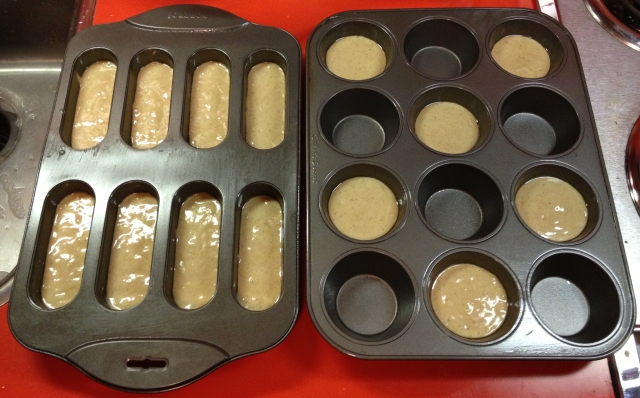
Batter portioned into prepared canoe pan using a ¼-cup measure to fill the cups halfway. Excess batter divided into six cups of a standard cupcake pan (prepped as with canoe pan).

 
Standard Pan Test Load: 8x Canoes + 6x Cupcakes

The canoe portion was baked at 320°F for 19+min. Cupcakes were baked in a separate oven, 14+min. at 325°F, also with water pan.

Batter expansion showed good habit, rising above pan surface while retaining flat-topped shape integrity; no “muffin-top” overflow. This suggests good moisture balance and a rise that does not cling unduly to the cup sides.


Perfect Rising Shape


Cooled cakes showed no signs of collapse.


Post-bake settling
Depanning was by inversion onto a parchment-covered surface. Release was quite clean this time.

Clean cake release

Trial 004A resulted in a moist, tender cake with good color and even open-cell surface structure. Canoe cake average weight about 28.6g, remarkably similar to earlier trials.


Perfect Shape & Color

Sensory evaluation & comments:

  • Attractive golden color
  • Sweet and fluffy
  • Good aroma and flavor
  • Good manual breakage and crumb integrity
  • Open-cell interior sponge ready for filing injection!
Overall the outcome of Trial 004A was satisfactory.

—

On the seventh day after baking, the last of the 002 cakes remained fresh-like and good, though they never were really great.

On the fourth day post-bake, the 003 cakes, never very good to start, are no fun at all; I have tossed the remaining ones. Besides being off-flavor, they had become quite gooey on the top (flat) surface, suggesting that they were underbaked in the first place, and possibly made worse by an excess of hygroscopic fructose from the honey.

—

Further cake-baking trials can wait while I ponder the issue of Luscious Creamed Filling. There are quite a few recipes around, generally falling into four classes:
  1. Whipped-fats-and-sugars: some variants hereof are rated highly for their resemblance to Twinkies filling; sometimes have milk added.
  2. Marshmallow-fluff: containing gelatin and sugar or corn syrups.
  3. Cheese or cheese-like: featuring mascarpone or cream cheese, or (*gag*) tofu or imitation soy-based faux-fromage.
  4. Boiled-starch-and-milk: these rely on forming an emulsion or suspension of fats within a gelled starch matrix.
I tend to favor the 4th category, thinking that the pre-gelled starch-and-milk cookup would be sterile (leg up on extended shelf life), and that such partial fat replacement would have “organoleptic” (yumminess & “mouthfeel”) and nutritional advantages. Progress on fillings R&D will be reported here...


 “—” ‘—’’

04 February 2013

Baking Trial 003 03 February 2013

Pushing the boundaries of the Sweet Spot in cake formulations, I went to the brink and promptly fell over. The result was Baking Trial Formulation 003, a failure by all accounts. Shows what comes from making too many changes at once.

It is recommended that nobody else try this because it is rather awful:

Flour, cake      95 g
Flour, RS Rice   15 g
Baking Pdr.       5 g
Baking Soda       - g
Sugar, gran.     82 g
Oil, canola      35 g, melted with

Short., palm    3.6 g (1 tsp.)
Salt, kosher    1.7 g
Eggs, whites     70 g (from 2 large eggs)
Eggs, yolks      38 g (from 2 large eggs)
Whey, sour       52 g (drained from skim milk yogurt)
Honey            22 g

Raisin purée     36 g
Vanilla ext.     5 ml
Lemon extract    8 drops
Extract, Sunflower kernel +25 g (from 1.0M extraction)


Mise-en-place setup was modified chiffon-style:

  1. Grind raisins, whey, and honey in blender. Filter, and combine with vanilla, lemon, sunflower extract.
  2. Sift together cake flour, RS rice flour, baking powder, 40g. of the sugar, and salt.
  3. Separate eggs, whites into meringue bowl with remaining 42g. sugar on the side; yolks into primary mixing bowl.
  4. Melt oil with shortening, let cool on the side of egg white.
  5. Preheat oven to 320°F; place pan of boiling water in rack under main rack.
  6. Baking pans ungreased.

Make-up as follows:

  1. Whisk egg yolks until ribbon stage;
  2. Gradually drizzle oil-shortening into yolks while whisking, making emulsion.
  3. Drizzle liquids mixture into yolk-sunflower mix, whisk until uniform.
  4. Disengage beaters and manually sift in flour mixture, mixing gently until fully moistened and uniform.
  5. With cleaned utensils, whip the egg whites until soft-peak is reached, then sift in sugar and whip until a medium-peak French meringue is formed.
  6. Lighten flour-egg batter with ¼ the meringue, then fold this into the remaining meringue until uniform.
The batter was portioned into the pan using a ¼-cup measure to fill the cups halfway. Each pan portion weighed about 34.7g. Excess batter was divided into six cups of a standard cupcake pan, two paper-lined.

The Canoe shape was baked at 320°F for 18min. Cupcake shapes were baked in a separate oven, 13 min. at 325°F, also with water pan.

Depanning was with an inverted slap against a sturdy wooden surface.

Canoe cake average weight was about 28.6g, for a baking loss of 18%: still a little high. Noticeable decrease in rise and final cake volume.

Trial 003 resulted in a moist, somewhat greyish cake with open-cell surface structure.

Sensory evaluation:
  • Fragile crumb, falls apart in mouth
  • Sweet, but not too too sweet
  • Noticeably heavy, chewy, and gummy
  • Weird smell; unexpected
  • Uneven sponge cell structure
Overall the consensus was Not Good. It is likely the un-neutralized acid of the raisins adversely affected the flavor. Excess RS rice flour and/or sunflower extract, and probably underbaking conspired to make a rather-less-than-fun experience.

Adjustment for next trial:
  • Revert to 002 formula and technique as new baseline.
  • Increase canoe baking time to 19-20min.

—

Happily, five days after baking, the 002 cakes remain fresh-like and quite yummy, longing though they are for a Luscious Creamed Filling to complete their existence.

More trial results coming up...

Beekeeping for Poets

 “—” ‘—’’

30 January 2013

Baking Trial 002 30 January 2013


Analysis of the sensory defects of Trial 001 proved most insightful. Feedback informed some alterations to the initial formula, and the results are much improved!

The Browne Crowe Bakes Sensory Evaluation Team took another bite of the now-24 hour old Trial 001 cakes, which were sealed in a locking food-storage container over the past day. Regrettably, and unlike fine wines, the NOT-winkie sans remplissage rev 001 has not improved with age, so the latest sampling compels the following to be added to the sensory-defect list:
  • gummy
  • heavy
  • squishy 
The ingredient proportions have been modified as listed, and the batter make-up has been tweaked somewhat. While better, it still falls short and must be adjusted further to address some issues listed later:

Flour, cake     100 g
Flour, RS Rice   10 g
Baking Pdr.       5 g
Baking Soda       1 g
Sugar, gran.     85 g
Oil, canola      36 g
Salt, kosher    1.7 g
Eggs, whites     72 g (from 2 large eggs)
Eggs, yolks      36 g (from 2 large eggs)
Whey, sour       52 g (drained from skim milk yogurt)
Honey            52 g
Vanilla ext.     5 ml
Lemon extract    8 drops
Extract, Sunflower kernel +20 g (from 0.5M extraction
)

Mise-en-place setup was modified chiffon-style:
  1. Stir together in plastic cup whey, honey, soda, RS rice flour, vanilla, lemon. Stir and let sit for 1hr., stirring occasionally.
  2. Sift together cake flour, baking powder, 40g. of the sugar, and salt.
  3. Separate eggs, whites into meringue bowl with remaining 45g. sugar on the side; yolks into primary mixing bowl with sunflower extract; oil on the side.
  4. Preheat oven to 320°F; place pan of boiling water in rack under main rack.
  5. Baking pans ungreased.
Make-up as follows:
  1. Whisk egg yolks & sunflower extract; do not expect classic ribbon consistency.
  2. Gradually drizzle oil into yolks while whisking, forming a loose emulsion.
  3. Drizzle liquid mixture into yolk-sunflower mix, whisk until uniform.
  4. Reduce mixer speed and sift in flour mixture, beating until fully moistened and uniform.
  5. With cleaned utensils, whip the egg whites until soft-peak is reached, then sift in sugar and whip until a medium-peak French meringue is formed.
  6. Lighten flour-egg batter with ¼ the meringue, then fold this into the remaining meringue until uniform.
Egg yolks plus sunflower extract

Lightening the batter with meringue portion
The batter was portioned into the pan using a ¼-cup measure to fill the cups halfway. Each pan portion weighed about 34.4g. Excess batter was divided into five cups of a standard cupcake pan, unlined.

Filled pan cups
The Canoe shape was baked at 320°F, and first tested at 15min. The center four cakes were still undone, so baking continued to 18min., whereupon the toothpick test passed. Cupcake shapes were baked in a separate oven, 12½ min. at 325°F, without water pan.


Cakes at half-done point

Finished baking
The cakes were allowed to cool somewhat, contracting slightly and pulling away from the cup walls a bit.

Depanned cakes, looking very familiar...

Depanning was with an inverted, vigorous slap against a sturdy wooden surface. Due to no release coating having been applied to the pan cups, it took several slaps to depan all cakes.

Cake pan-skin stuck to the cup - quite a cleanup!

Cake average weight was about 27.3g, for a baking loss of  1-(27.3/34.4)=21%: still a little high, but not overbaked this time.


Trial 002 resulted in a moist, somewhat supple cake with the highly desired Twinkie-like external open-cell surface structure, in contrast to the greasy-floury puckered elephant-skin of Trial 001.

Sensory evaluation:

  • Sweet, but not too too sweet or cloying; more dessert-like
  • Slightly sticky (but so are Twinkies!)
  • Squishy, but in a good way
  • Puffy texture
  • Taste is “way better”
  • The note of lemon is a pleasant surprise
  • Better sponge fineness and uniformity
  • Cupcakes were overbaked with a slight egginess
It would seem that presoaking the RS rice flour eliminated the gritty after-sensation, and that neutralizing the acidic honey and whey with the soda is best done during the presoak, rather than adding the dry soda to the flour mixture.

Even though the egg yolks being whipped with the sunflower extract “ruined” the expected ribbon stage of yolk whipping, that last canonical step’s disappearance did not seem to make much difference to the end result, much less spoil the batter.

Adjustment for next trial:
  • Research in-batter additions or ratio tweaks for aiding release from pan; chiffons must cling to pan for gas-sponge support and for resisting shrinkage while cooling, but release is a insufficient for production.
  • Ensure that eggs are the freshest possible. One member of The Browne Crowe Bakes Sensory Evaluation Team is especially sensitive to egginess.
  • Reduce cupcake baking temperature a bit, and add a hot-water pan to the second oven.
More trial results to follow...


Beekeeping for Poets

 “—” ‘—’’


Baking Trial 001 29 January 2013


First trial! An initial formula was scaled to provide cakes sufficient for a week’s worth of shelf-life testing—assuming the result would be edible in the first place!

The basic shape of the NOT-winkie until further notice will result from the Norpro pan as shown below. For the home and blogger-experimenter this will have to do, even though it has only eight cups and a dark, nonstick coating that interferes with the baking and release processes.

Norpro 3964 “Cream Canoe” pan
Now I’ll list the ingredients below with the understanding that the result falls far short of Golden Sponge Cake perfection. I do not recommend using it:

Flour, cake     100 g
Flour, RS Rice   10 g
Baking Pdr.       5 g
Baking Soda       1 g
Sugar, gran.     85 g

Oil, canola      60 g
Salt, kosher    1.7 g
Eggs, whites     75 g (from 2 large eggs)

Eggs, yolks      34 g (from 2 large eggs) 
Whey, sour       52 g (fresh-drained from skim milk yogurt)
Honey            52 g

Vanilla ext.     5 ml
Extract, Sunflower kernel +10 g

Mise-en-place setup for the batter make-up was basic chiffon-style:

  1. Sift together flours, leavenings, ½ the granular sugar, and salt.
  2. Separate eggs, whites into meringue bowl with other ½ sugar on the side; yolks into primary mixing bowl.
  3. Mix liquids: whey, vanilla, honey, and sunflower extract.
  4. Grease (palm shortening) and flour Canoe pan cups (mistake; see below)
  5. Preheat oven to 320°F; place pan of boiling water in rack under main rack.
Make-up as follows:
  1. Whisk egg yolks until ribbon stage.
  2. Gradually drizzle oil into yolks while whisking, forming a mayonnaise-like emulsion.
  3. Drizzle liquid mixture into yolk emulsion, whisk until uniform.
  4. Reduce mixer speed and sift in flour mixture, beating until fully moistened and uniform.
  5. With cleaned utensils, whip the egg whites until soft-peak is reached, then sift in sugar and whip until a medium-peak French meringue is formed.
  6. Lighten flour-egg batter with ¼ the meringue, then fold this into the remaining meringue until uniform.
The batter was then portioned into the pan using a ¼-cup measure to fill the cups halfway. Each pan portion weighed about 37.7g. Excess batter was divided into six cups of a standard cupcake pan lined with papers.

Prepped pan and batter
Baking for the Canoe shape was 20min. at 320°F. Cupcake shapes were baked in a separate oven, 15min. at 320°F, without water pan.

First batch looking pretty plump

Remove respective pans after passing toothpick tests, let cool with all-around air circulation.

Pan of canoes post-bake


Depan canoes while still warm by inverting with smart drop onto cutting board.

Torpedoes, Trial 001
Cake average weight was 30.3g, for a baking loss of  1-(30.3/37.7)=20%: a little high, probably overbaked.


Sensory evaluation:
  • Too sweet
  • Slight tongue-coating greasiness
  • Chalky-gritty residue left on teeth
  • Good texture
  • Sponge cells a little uneven
  • Good vanilla flavor
  • Notable lack of egg taste or aroma
  • Cake skin wrinkly-puckered

Resolution and adjustment for next trial:

  • Reduce liquid oil content
  • Pre-hydrate RS rice flour
  • Blend meringue into egg-flour batter a little longer
  • Reduce sugar in meringue; try cream of tartar as foam stabilizer
  • Mix soda with whey-honey (neutralize) rather than add to flours etc.
  • Do not grease/flour pan; try alternate release means.
  • Try hydrolyzed sunflower lecithin
  • Add a drop or two of lemon oil
  • Test for doneness at 17min.

The Browne Crowe Bakes Sensory Evaluation Team will continue evaluating Trial 001 cakes over the next week, to check for shelf-life related issues. 

So what is this Sunflower Kernel Extract Stuff, Anyhow?


Well,  sunflower kernels contain a lot of lecithin, some good oils, proteins, and a good bit of vitamin E, all of which should have some utility in NOT-winkies.

Grains & seeds being tried for additives
While remaining a little vague about exactly the processes used, I will say that after studying and discarding various patent processes for isolating this or extracting that, I have settled on a simple kitchen-counter method using ordinary ingredients and household appliances.

These suffice to make a smooth “cream” that is yummy and inoffensive for inclusion into NOT-winkies. It is probably also deliriously nutritive, but again lacking a food analysis lab, I’ll have to rely on the USDA NAL Database to guess what goodness resides in the NOT-winkie.


Mysterious extracts of sunflower kernels

Trial 002 due to start soon...


Beekeeping for Poets

 “—” ‘—’’

26 January 2013

Canonical Cakes


Things are heating up in the Top Secret R&D Lab of Browne Crowe Bakes. A special resistant-starch preparation of germ-retained rice has been turned into flour, ready for baking trials. As I type I have test quantities of sunflower kernels undergoing alchemical transformation into various emulsifier, protein, and oil preparations, with synergistic combinations possibly workable into the pre-batter phase of a chiffon-like formula.

To this end, one might wonder what the starting point must be in making any cake, especially the Golden Sponge Cake component of the NOT-winkie:

The Fundamentals of Formulæ


Professional bakers have several rules of thumb for “balancing” the proportions of cake ingredients to get the mix In The Zone of desired cake properties. The three general guidelines of cake formulation go as follows—quantities refer to weight, not volume measure:

  • Sugar should equal or exceed flour (sugar>flour is called “high ratio”)
  • Eggs should equal or exceed fats
  • Eggs plus other liquids should equal or exceed sugar

For most published cake formulas, these rules seem to hold up pretty well. As demonstrated in previous weblog posts here (see), no useful information or conclusions can be got about the actual amounts of eggs, flour etc. in Twinkies.

What is more interesting and relevant to anybody with a college education is to look at the breakdown of specific food components—starches, fats, protein etc.—such that batter formulas can be better “tuned” to meet specific functional goals, e.g. the shelf-life of our NOT-winkies.

Analyzing the macronutrient breakdown of eight cakes in the same class as Golden Sponge Cake, and contrasting again with the bare-bones nutritional labeling of the archetypal Twinkie, we find these figures emerging (the ± is attached to the standard deviation, for all you engineers, boffins, and statistics wonks):

Component    Classic Cake    Twinkie
Sugars        26.3% ±3.2%      42%
Starches      19.1% ±2.4%      21%
Protein        4.9% ±0.7%       2%
Water         33.6% ±5.8%      24% (guess)
Fats          15.5% ±4.4%      11%


Digging deeper we can examine the ratios between macronutrient components:

Component Ratio    Classic Cake    Twinkie
Starches:Protein     4.0 ±0.6        9.0

Fats:Protein         3.2 ±0.8        4.5
Fats:Starches        0.8 ±0.3        0.5
Sugars:Starches      1.4 ±0.2        2.0
Sugars:Protein       5.5 ±0.8       18.0
Water:Sugars         1.3 ±0.4        0.6
Water:
Starches       1.8 ±0.4        1.1

The notable deviations of the Twinkie well outside “natural” macronutrient measures, in both percentage content and content ratios, are no doubt made possible by all those lovely additives. I seriously doubt anyone could make a scratch-cake using the Twinkie proportions without lots of help from the Better Living Through Chemistry crowd.

Sweet Secrets to Shelf Life


As it turns out, one ratio especially relevant for shelf life is the sugar:starch figure. This should be in the range 1.5 to 3.1, so you can see right away that whereas most classic cakes sit on the low end at 1.4, the Twinkie is right there at a solid 2.0.

In the case of the Twinkie, but irrelevant to the NOT-winkie, is that underlying the rich sugar:starch ratio are the aggressive nonfood shelf-life extenders: caseinates, dextrin, HFCS, MGL & DGL, Polysorbate 60, SSL, and soy flour.


Another little card the NOT-winkie has up its sleeve comes from the old-European tradition of Honey Cakes, well-known for their staying moist and good to eat for many days if not weeks after baking. These were devised in a era when cane or beet sugar was scarce, preservatives as we know them were non-existent, and shelf-life was not a dirty word.

The trick is to replace 100% sugar with a sugar mix having a disaccharide : monosaccharide ratio of about 2:1. More likely than not, this is what Hostess did with Twinkies—although the exact proportions are unknown—where the disaccharides comprise sugar and whey lactose, and the monosaccharides glucose and fructose (lævulose) are supplied by added dextrose and HFCS. Recall that fructose is humectant, that is, it draws and holds water molecules aka moisture.

For the NOT-winkie, our natural equivalent would be to substitute, say, 1 cup (225g) of sugar with 2/3 cup sugar (150g) plus 75g÷82% sugars÷1.425g/ml = 64.2ml (1/4 cup plus 1 tsp.) honey, adjusting the formula to account for the 3 1/3 tsp. water present in the honey. Courtesy of floral sources and honey bees’ industry, honey sugars are about half fructose, so the moistness we expect will be present in the NOT-winkie as well.

I am not opposed to the use of glucose/dextrose per se, but if a non-maize dextrose source such as rice or tapioca could be found, it might find its way into the sponge and/or filling of our next-generation Golden Sponge Cake as a means of optimizing sweetness (honey can be too sweet), while maintaining a reasonable shelf life.


 Beekeeping for Poets

 “—” ‘—’’

22 January 2013

Ambiguousity of the Week:

(Anti)nutrients, or What Is Fit To Eat?

In my quest for additive-free additives for the NOT-winkie, over the past week of intensive study I’ve found myself wading through a mire of patents and scientific reports on “functional” extracts from seed, grains, and dairy.

“So what?”, one might think. Well, here’s what: I soon discerned the reductionist-reconstructionist mindset of the food-processing industry: take some agricultural by-product left over from pressing or milling, and isolate a set of nutrients—proteins, gums, starches etc.—therefrom, stripping away bothersome components along the way. Quite frequently the goal is to produce some odorless, tasteless white powder that can be slipped into the food stream to great potential profit—while displacing recognizable food that must be eliminated to keep down costs.

One recent example, US7989017, deals with isolating protein from leftover canola seed—aka low-erucic acid oilseed rape—after the oil’s been pressed or solvent-extracted. As with dairy whey, canola pressing cake, a by-product formerly known as landfill, river effluent, or hog-feed, is being recycled as food. Not as bad as Soylent Green, maybe, but there are huge financial incentives to manage the canola oil industry waste stream.

A poser: How likely is it that the whole “Reduce-Reuse-Recycle-Rethink” mantra of urban Greenies and Effetes is just a Capitalist-Agroindustrial softening-up artifice to persuade you and me to eat garbage? Chew on that one for a while... but I digress.

Chlorogenates and Phytates: Poisons or Panaceas?


I like the sunflower, Helianthus annuus, esthetically for its blossoms, and nutritionally as a seed-food. For the NOT-winkie, there is potential here as a combined source of protein, lecithin (emulsifier mixing aid), tocopherols (vitamin E), and dietary fiber.

Thing is, academia and the agro-food industry have a problem with stuff also found in sunflower: chlorogenates and phytates. As with canola, there is huge potential profit in further squeezing sunflower kernels for all they’re worth, but these bothersome molecules discolor proteins (chlorogenic: chloro-color, and gennan-produce; scientists are so clever with their pseudo-Greek) and interfere with the extraction of protein.

Chlorogenates, in particular Chlorogenic acid (CA) is present in many plant foods, with high levels in coffee, tea, sunflower kernels, blueberries, and coriander aka cilantro. CA has been fingered as an allergen and laxative (found in the skin of prunes), and binds with dietary calcium, magnesium, zinc, and iron, reducing these nutrients’ availability. Must be bad, right? Not so fast...

CA, while having an antinutrient aspect, seems to improve one’s blood-sugar glycemic/insulin response, has a mildly-psychostimulatory effect similar to caffeine, increases one’s sense of well-being, and moderates blood pressure. CA is actually sold as a “fat burning” dietary supplement. So... maybe not so bad.

Phytates, notably Phytic acid (PA) is another mixed bag. PA too is found in most grains and seeds, and as antinutrient also chelates or binds with calcium, magnesium, iron, and zinc, and interferes with uptake of protein, fats, and the B-vitamin niacin, hypothetically setting one up for a deficiency in these essential nutrients. Bad thing, eh? Well, it seems PA’s sword swings both ways.

PA as a chelator also reduces kidney stone formation and heavy metal toxicity. Alzheimer’s disease, which has an etiological factor of aluminum and other heavy-metal overload, may benefit from PA therapy. It is also has antioxidant properties, and may be useful against cancer due to its cancer-cell interference and immune-stimulatory properties. It also has found therapeutic use against diabetes, atherosclerosis, and coronary heart disease.

Chlorogenates and Phytates are mentioned here in a NOT-winkies context because, unlike the aforementioned agriculture-waste salvage industry, Browne Crowe Bakes will make no strenuous effort to remove them from ingredients going into the mixing bowl.

Monet’s Yellow Bane


A dirty little secret of the wheat, sunflower, and tobacco agroindustries is that these plants are adept in sucking up Cadmium from certain salty or clay-rich soils. Due to its wide use in industry, environmental contamination is pervasive and occasionally severe. This is a toxic, nasty little element that competes with zinc, selenium, copper and other minerals in the body.

There are few biochemical processes in the body that cadmium does not fvck up, and its effects tend to build with age and exposure. French Impressionist painter Claude Monet (1840-1926) liked to use cadmium yellow paint, but it finally killed him after years of slow, painful degeneration.

There’s a bit of a rush on to develop wheat and sunflower cultivars that show less cadmium uptake (gee, thanks!), and an industry-wide trend to kick to the curb those farmers who may have to grow on cadmium-rich soils rather than abandon the farm.

In the meanwhile, and on the bright side, the body knows how to rid itself of cadmium, but it needs other nutrients to help: adequate calcium, manganese, selenium, zinc, copper, and vitamins C, D and E in the diet helps one’s body displace, bind, and excrete cadmium. Happily, sunflower kernels also contain many of these nutrients as a kind of build-in antidote; nice.

—

It has been a flurry of activity of late, gathering resources and performing preliminary trials (monkeying around) in the Top Secret R&D Lab of Browne Crowe Bakes.

I have some encouraging protein-lipid extracts of sunflower and preparations of resistant starch ready to try, and the other day I received my Norpro 3964 Cream Canoe set for upcoming baking trials.


 Beekeeping for Poets

 “—” ‘—’’

16 January 2013

—Musings—

Transition to a Higher Quality of
Food As We Know It

The first trials of natural replacements for synthetic additives, and in squeezing out corn- and soy-based ingredients, initially texturizers, modifiers, emulsifiers, etc. have commenced in the top secret R&D Lab of Browne Crowe Bakes. Results (only the good ones) to be reported this weblog as/when/if they appear.

In the mean time—


Consider now some additions—not additives—that might increase the food value of the NOT-winkie. Making a Golden Sponge Cake that is good and good for you, are you kidding? Well, no.

Reality check: over eight decades, by means of ever-cheaper ingredients and food substitutes, necessitated by rising costs—materials and labor—and bizarre market-driven shelf-life demands, the Twinkie became mostly non-food. Along the way as well, Twinkies fans gradually became used to the unrealistically-low price of an unreal food.

So, going back to first principals, making the NOT-winkie into food (again) will demand that actual food go into it, and that customers suck up the higher price and like it.

Oat Bran Redux: A “Heart Healthy” Golden Sponge Cake?


Some readers may recall the Oat Bran craze, starting in the late 1980s. Everything was oat bran this, oat bran that, lowers yer cholesterol yadda yadda; bit annoying, really. The fractions of oats or oat bran that does the trick are soluble-fiber molecules called beta-glucan, a set of polysaccharide polymers which lends a slippery or gluey texture to oatmeal (porridge). The craze may have abated, but could there be a role for this stuff in NOT-winkies? Depends.

In order to qualify for the FDA-approved “heart health” claim, foods must contain a minimum of 0.75g beta-glucan soluble fiber per serving. For the NOT-winkie, this would mean 375mg or 3/8g per cake, which is about the amount of beta-glucan found in 7.5g of dry oatmeal (3/16 of a typical serving), or in 5g of oat bran.

Well, using 7.5g whole oat flour would just about fill the flour budget for our new Golden Sponge Cake. It is unknown what this would do to the crumb texture and appeal, but based on numerous futile attempts to make just-oats work on anything other than oatmeal or crackers—we’d probably make a totally gummy yuk.

It might be advantageous then to use a beta-glucan concentrate instead. There are products like this that could be added at only 536mg per cake to legally make those wild and crazy FDA claims.

More food additions To Be Discussed (readers encouraged to suggest)...


 “—” ‘—’’

14 January 2013

—Interjection—

Transition to a Higher Content of
Food As We Know It

It should not be too much to imagine that the NOT-winkie could asymptotically approach actual food, given what’s now known about nutrition, nutrients, and anti-nutrients. An emerging concern—not just over Twinkie-like foods—is over the unique molecules formed by exposure to high heat and dehydration—baking, frying, broiling—and by the modern tortures of microwave and ionizing irradiation.

Natural Preservation


I’ve always tried to honor the meme of “Eat only those foods that will spoil... but eat them before they do spoil.” Yes, that’s all very well, but reasonable durability on the shelf or in the brown bag is not too much to ask in this case. The NOT-winkies Experience, as with its Twinkies predecessor’s, must be gay—old definition: joyful and carefree—and not cause undue worry about spoilage.

The bog-standard Twinkie relies on sorbic acid, high sugar and salt content, and scant levels of perishable ingredients to extend shelf life to the one-month mark. In making the transition to food-based ingredient functions in NOT-winkies, some natural solutions against rot & rancidity begin to come into focus:

Antioxidants:

To retard rancidity of oils & fats, there are some natural substances to consider including:
  • Cinnamon (Cinnamomum spp.) bark oleoresin and extracts
  • Lemongrass (Cymbopogon citratus) extract
  • Rosemary (Rosmarinus officinalis) extract
  • Turmeric (Curcuma longa) extract
  • Blends of ascorbyl palmitate (vitamin C reacted with palm oil), lecithin, and tocopherols (vitamin E)
Antimicrobials:
And to stop pathogenic microbes taking up residence in your Golden Sponge Cake:
  • Allspice (Pimenta dioica) extract
  • Coriander (Coriandrum sativum) extract
  • Cinnamon (Cinnamomum spp.) leaf extract
  • Curry tree (Murraya koenigii)  leaf extract
  • Lemongrass (Cymbopogon citratus) extract
  • Lemon thyme (Thymus x citriodorus) extract
  • Cranberries (Vaccinium spp.): contain natural benzoates
  • Prune (Prunus domestica) juice: contains malic, benzoic and salicylic acids
  • Raisin (Vitis spp.) paste: contains propionic acid (mold inhibitor), and tartaric acid
  • Cultured whey serum: contains acetic, propionic, and lactic acids
As you can see, many common dietary spices and fruits tend to possess strong antimicrobial and antioxidant properties in foods and in vivo. The most potent ones include marjoram, rosemary, clove, cinnamon, allspice, thyme, basil, coriander, cumin, fennel, oregano, savory, and nutmeg. Their antioxidant capacity is strongly related to their total phenolic acid content.

If including these natural preservative foods, how a NOT-winkie would actually taste is another matter. It could be that the price of giving up sorbic acid would be moving from a bland, vaguely vanilla-ish flavor to a pleasantly-scented treat with notes of cinnamon, nutmeg, and cloves. Could do worse...

Mix in berry and fruit concentrates, and the antimicrobials hitch a ride with the appealing natural aromas and flavors. Thus the artificial flavors get pinged, and the reds and yellows of cranberries and turmeric (and maybe carrot carotene pigments, aka pro-vitamin A) allow dispensing with the artificial colors too.

Sweet! and Shelf Life: Look to the bees


The lævulose (fructose) in the artificial sweetener high-fructose corn syrup (HFCS) functions as a humectant, attracting and holding moisture to help keep Golden Sponge Cake tender. Since HFCS is out, natural alternatives would be a little hard to find if it weren’t for honey. Honey has of course been sought after, hoarded, and prized by mankind for millennia, none of which can be said for HFCS.
 
Honey bee workers process floral nectar into proto-honey by adding Diastase and Invertase enzymes, which break down starches into dextrins and simple sugars, and disaccharide sugars into dextrose (glucose) and lævulose (fructose). After a little evaporation and maturation in open honey comb cells, the workers cap the comb for safekeeping for future energy needs.

Adding honey at 6%-7% of the dry granular sugar’s weight would be more than enough to keep our reformulated NOT-winkie moist and sweet!, while throwing a bone to regional beekeepers by boosting honey-production income.

Food Abuse: RoHS meets modern baking


There is a substance produced whenever a foodstuff containing both amino acids (protein) and reducing sugars (glucose, fructose) is hit with high temperatures under low-moisture conditions: Acrylamide, known as prop-2-enamide to the chemistry wonks. As one of a broad class of Heat-Generated Food Toxicants (HEATOX), acrylamide is widely found in common consumables such as fried potatoes (french fries/chips and potato chips/crisps), coffee, and tobacco smoke.

Regrettably, we find acrylamide especially in the dry, heavily-browned parts of baked goods such as bread crust, crispy cookies, and (almost certainly) the soft, brown layer of a Twinkie that sticks to the card stock insert of the packaging.

The FDA and WHO have been kicking the acrylamide can down the road for a quite while now, ever since it was found to be neurotoxic and hypothetically carcinogenic. The strongest action taken, apart from a few low-profile Nanny-State lawsuits, has been to encourage food processors to take steps to reduce acrylamide levels in their products by, say, 50%. To avoid alarming the public with or further desensitizing us against yet another health scare, little concerning acrylamide has been released by the three-letter bureaucracies.

To be proactive and foster consumers’ need for a little prudent avoidance of acrylamide, the formulation and baking of NOT-winkies could beneficially incorporate one or more of these elements:

  • As baking progresses and the cake begins to dry out, retard the Maillard reaction by reducing the baking temperature to under 154C (309°F)
     
  • Find a way to bake at the lowest possible temperature, say T < 135C (275°F) or preferably < 121C (250°F)
     
  • Avoid heavy browning & hard crust formation

  • Investigate steam and infrared (radiant heat) cooking methods
     
  • Reduce protein and simple-sugar content; well... not likely
     
  • Add nutmeg as spice/antioxidant; it may reduce acrylamide formation
     
  • Consider live yeast as a processing step; it gobbles up acrylamide precursors
     
  • Adding calcium salts e.g. calcium sulfate aka edible gypsum as a possible acrylamide inhibitor
     
  • Show this to your parents and say humbly but firmly, “See? I was right to ask to have the crusts cut off my sandwiches!”

So spices, honey, and baking-method alternatives seem likely, necessary, inevitable, and probably why not?-welcome in the NOT-winkies milieu.

—
 
BTW acrylamide and other HEATOX compounds such as AGEs and HMF were all brought into the human diet ever since the clever notion of cooking food caught on.

And then there are the unknowns resulting from irradiating foods with gamma radiation (look up URPs), and just what microwave heating or cooking does to food.

So whaddya gonna do, except strive to avoid overheated, scorched, burned, roasted, overcooked, nuked, and old foods?
 
Coming up:
Interjection: Transition to a Higher Quality of Food As We Know It


 “—” ‘—’’